
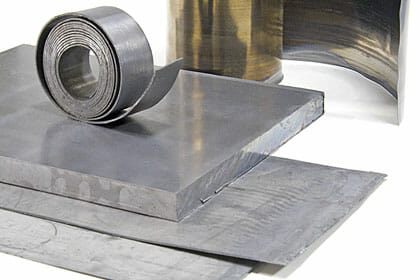
Nuclead supplies in-stock and custom fabricated lead sheet metal (lead metal sheet) for radiation shielding, aerospace, scientific research, and construction restoration applications.
We offer both in-stock standard lead sheet sizes for fast shipment and custom-fabricated lead sheet solutions built to specification.
Pure lead (Pb) and antimony products are available in standard sizes or custom, depending on your sound reduction material, radiation sheeting or x-ray plate needs. Materials for neutron shielding and nuclear shielding are available. We also offer pure cadmium sheeting and calcium lead sheeting.
Nuclead is a U.S.-based manufacturer of stock and custom lead sheet metal, supplying ASTM-compliant materials for radiation shielding, aerospace and defense, scientific research, construction restoration, and industrial applications.
Why buy our lead products?
- ASTM-Compliant Materials
- In-Stock Standard Sizes
- Fast Shipping Available
- Custom Cut-to-Size Fabrication
- ISO 9001:2015 Certified
- Made in USA
Quick Specs
| Material | Pure Lead (Pb) |
| Compliance | ASTM |
| Thickness | 1/64″ – 3″ |
| Width | 1/8″ – 96″ |
| Lengths | up to 25′ |
| In Stock sizes | Yes |
| Custom cuts | Yes |
| Lead times | Days |
Lead Sheet
Lead Sheet has multiple uses, including radiation shielding, nuclear shielding, tank linings, lead flashing, sound-proofing, vibration absorbers, x-ray shielding, lead gaskets, lead ballast, and corrosion-resistant lining.
Lead Alloy Sheets
Because lead is very soft and ductile, it is often used commercially in lead alloys. Lead-Antimony and Tin Lead are common alloys.
Antimony is generally used to give greater hardness and strength to lead sheets and lead plates used for applications like storage battery grids. Antimony contents of lead-antimony alloys can range from 0.5 to 25%, but they are usually 2 to 5%.
Adding tin to lead or lead alloys increases hardness and strength, but lead-tin alloys are more commonly used for their good melting, casting, and wetting properties, as in type metals and lead solders. Tin lead the principal ingredients of many low-melting lead alloys.
Lead Foil
What is lead foil?
Lead Foil, is a form of sheet lead that is thin enough to be easily cut and formed using shears. Lead foil can be stamped or formed into almost any shape so that it can be placed around any area that needs protection. Lead foil is often supplied backed with pressure-sensitive adhesive or vinyl to aid the application of the product.
We provide any size to the tenth of a thousand (.0000″) from .0020″ to .0310″ thick. Widths 1/8″ wide and up, lengths up to 200′ long. Our foils are rolled on heavy duty fiber cores. End caps can be provided to protect against shipping damage. This allows a perfect roll on your dock.
Lead Foil value added – We will laminate your foil with pressure sensitive adhesive (PSA), PSA with release paper, vinyl or any other product specified. We can stamp, laminate or assemble any application.
Specifications for Common Lead Sheet, Plate & Foil Lead Thickness & Size Chart
(any thickness can be fabricated to .001″)
| Lbs per SF Common, Chemical or Antimonial Lead | Actual Thickness (inches) | Maximum Size (feet) |
||
|---|---|---|---|---|
| Decimal | Fraction | Width | Length | |
| N/A | 0.002-0.031 | N/A | 1.5 | 200 |
| 1 | 0.016 | 1/64 | 4 | 20 |
| 2 | 0.033 | 1/32 | 8 | 24 |
| 2.5 | 0.041 | 1/24 | 8 | 25 |
| 3 | 0.05 | | 8 | 25 |
| 3.5 | 0.058 | | 8 | 25 |
| 3.75 | 0.063 | 1/16 | 8 | 25 |
| 4 | 0.066 | | 8 | 25 |
| 5 | 0.082 | 1/12 | 8 | 25 |
| 6 | 0.1 | 1/10 | 8 | 25 |
| 6.5 | 0.105 | | 8 | 25 |
| 7 | 0.117 | | 8 | 25 |
| 7.5 | 0.125 | 1/8 | 8 | 25 |
| 8 | 0.133 | | 8 | 25 |
| 10 | 0.167 | 1/6 | 8 | 20 |
| 11.25 | 0.187 | 3/16 | 8 | 20 |
| 12 | 0.2 | 1/5 | 8 | 20 |
| 15 | 0.25 | 1/4 | 8 | 20 |
| 16 | 0.267 | | 8 | 20 |
| 20 | 0.333 | 1/3 | 8 | 20 |
| 22.5 | 0.375 | 3/8 | 8 | 15 |
| 24 | 0.4 | 2/5 | 8 | 15 |
| 30 | 0.5 | 1/2 | 8 | 15 |
| 40 | 0.667 | 2/3 | 8 | 15 |
| 45 | 0.75 | 3/4 | 8 | 15 |
| 60 | 1 | 1 | 8 | 15 |
| 120 | 2 | 2 | 8 | 8 |
| 180 | 3 | 3 | 8 | 8 |
Lead Sheet for Soundproofing
Sheet lead is quite effective as a soundproofing material. Lead sheets provide effective noise absorption, being over 10 times more absorbent than glass or concrete and up to 100 times more absorbent than wood.
Additional lead soundproofing information can be found by clicking this link
| Lead for Noise Control: Lead verses other materials (approximate thickness required in inches) |
|||
|---|---|---|---|
| Material | Moderately Noisy Office | Quiet Office | Very Quite Office |
| Fir Plywood | 3.67″ | 6.67″ | 13.33″ |
| Sand Plaster | 0.2″” | 4.45″ | 8.9″ |
| Glass | 0.13″ | NA | 9.3″ |
| Dense Concrete | 0.14″ | 4.85″ | 12.2″ |
| Aluminum | 0.13″ | 5.7″ | 11.3″ |
| Steel | 0.045″ | NA | 7″ |
| Lead | 0.03″ | 0.135″ | 0.54″ |
Lead Sheet for Shielding
Lead shielding refers to the use of lead to protect people or objects from radiation. Lead sheets can be used to effectively attenuate certain kinds of radiation because of lead’s high density and high atomic number. Sheet lead is very effective at stopping alpha rays, gamma rays, and X-rays. A sheet of lead is only somewhat effective for neutron radiation.
This material is used for X-ray shielding and nuclear radiation shielding at power plants, labs, and military installations.
| X-Rays generated by peak voltages not exceeding | Minimum thickness of Lead | Weight per Square Foot in Pounds | |
|---|---|---|---|
| Millimeters (mm) | Inches | ||
| 75 kV | 1 | 0.039 | 2.5 |
| 100 kV | 1.5 | 0.059 | 4 |
| 125 kV | 2 | 0.079 | 5 |
| 150 kV | 2.5 | 0.098 | 7 |
| 175 kV | 3 | 0.118 | 8 |
| 200 kV | 4 | 0.157 | 10 |
| 225 kV | 5 | 0.197 | 13 |
| 300 kV | 9 | 0.354 | 24 |
| 400 kV | 15 | 0.591 | 38 |
| 500 kV | 22 | 0.369 | 56 |
| 600 kV | 34 | 1.343 | 81 |
| 900 kV | 51 | 2 | 120 |
Additional Lead Sheet applications information can be found at this link
For a complete listing of products available on this site, go to the products and services index page
Frequently Asked Questions About Lead Sheet Metal
Lead sheet metal is rolled or plated lead (Pb) material used in radiation shielding, construction restoration, vibration damping, ballast, and industrial manufacturing applications. Nuclead supplies both stocked and custom fabricated lead sheet solutions for commercial and industrial use.
Yes. Nuclead stocks select standard lead sheet sizes for fast shipment, with typical lead times measured in days. We also provide custom cut-to-size fabrication to your specifications for industrial, scientific, aerospace/defense, and construction applications.
Yes. Nuclead supplies ASTM-compliant lead products and is ISO 9001:2015 certified. Our materials are manufactured in the USA, and we are a U.S.-based supplier located in Massachusetts.
Standard sheet lead is available, and Lead foil is offered as specified in the table above. Custom cut-to-size and custom thickness options are available; contact us with project-specific requirements.
Yes. Nuclead provides custom cut-to-size lead sheet fabrication for industrial, scientific, aerospace, defense, and construction applications.
Yes. Lead sheet is commonly used for x-ray shielding, radiation barriers, isotope handling, nuclear shielding, medical imaging facilities, and laboratory radiation protection because of lead’s high density and shielding effectiveness.
The required thickness depends on radiation energy levels, shielding design, and the specific application. Refer to the table above for minimum thickness per kV. The manufacturer of the radiation equipment usually specifies the thickness needed.
Lead sheet is used across many industries, including:
- Radiation shielding
- Aerospace and defense
- Scientific research
- Medical applications
- Construction and historic restoration
- Industrial manufacturing
- Offshore and energy applications
- Marine use for engine rooms sound dampening
Yes. Lead sheet is used in aerospace and defense applications for ballast, vibration damping, shielding, and specialized engineered components. Nuclead supports industrial and mission-critical applications requiring precision lead fabrication.
Yes. Lead sheet is commonly used in construction and restoration projects for flashing, waterproofing, soundproofing, and historic building restoration applications where durability and malleability are important.
Lead sheet typically refers to rolled lead material of medium thickness used across shielding and industrial applications. Lead foil is thinner and more flexible, while lead plate is thicker and used for structural, shielding, adding dense weight, or high-density industrial applications.
Yes. Nuclead is a U.S.-based manufacturer and supplier of stock and custom lead sheet metal serving industrial, scientific, aerospace, defense, radiation shielding, and construction markets. we are located in Massachusetts.
What are the main applications for your lead sheet and alloys? Short answer: Applications include radiation and nuclear shielding, X-ray barriers, tank linings, lead flashing, soundproofing and vibration damping, gaskets, ballast, and corrosion-resistant lining. We serve industries such as aerospace and defense, scientific research, medical, construction and historic restoration, industrial manufacturing, offshore/energy, and marine (e.g., engine room sound dampening).
Whether you need stocked lead sheet or a custom fabricated solution, our team can help.
For detailed pricing quote fill out our request a quote form